If you're working on any concrete construction project, you'll eventually need to know how to cut steel rebar. Rebar (reinforcing bar) arrives at job sites in standard lengths—typically 12 meters—and must be cut to your exact specifications before placement in concrete forms.
This guide covers the most practical methods for cutting rebar, from simple manual tools to powerful hydraulic cutters, along with essential safety tips and key specifications you need to know.
What Is Steel Rebar?
Steel rebar is a carbon steel bar with surface deformations (ridges) that create a strong mechanical bond with concrete. It provides the tensile strength that concrete alone lacks.
Steel Rebar Types
| Type | Best Applications |
| Carbon Steel (standard) | General construction, residential, commercial |
| Epoxy-Coated | Bridges, marine environments, parking structures |
| Galvanized | Coastal construction, harsh environments |
| Stainless Steel | Critical infrastructure, premium projects |
Steel Rebar Grades (Tensile Strength)
Grade 40: 40,000 psi yield strength
Grade 60: 60,000 psi yield strength (industry standard)
Grade 75: 75,000 psi yield strength
Grade 80: 80,000 psi yield strength
Steel Rebar Size Chart
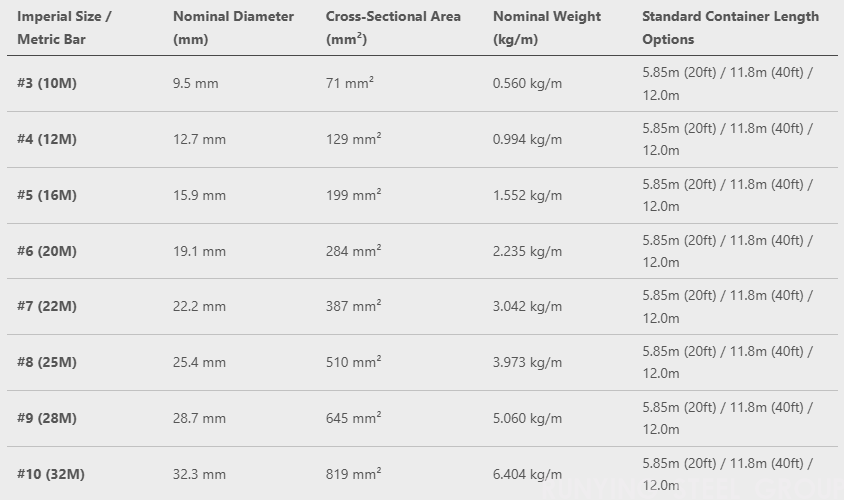
| Bar Size | Diameter (mm) | Weight (kg/m) | Common Use |
| #3 (10mm) | 9.5 | 0.56 | Slabs, driveways |
| #4 (12mm) | 12.7 | 1.00 | Columns, footings |
| #5 (16mm) | 15.9 | 1.56 | Beams, retaining walls |
| #6 (19mm) | 19.1 | 2.24 | Heavy foundations |
| #7 (22mm) | 22.2 | 3.05 | Bridges, high-rises |
| #8 (25mm) | 25.4 | 3.98 | Commercial structures |
| #9 (29mm) | 28.7 | 5.07 | Heavy industrial |
Smaller sizes include steel rods 6mm, 5mm, and 3mm for light reinforcement. The 7 rebar diameter is 22.2mm, while 9 rebar size is 28.7mm.
Weight Calculations
Steel rebar weight per meter formula: Weight (kg/m) = d² × 0.006165
Steel rebar 10mm: 0.617 kg/m
Steel rebar 12mm: 0.888 kg/m
Steel rebar 16mm: 1.58 kg/m

Safety First: Essential Precautions
Before learning how to cut steel rebar, understand these critical safety rules:
Required PPE
Safety glasses with side shields
Heavy-duty work gloves
Hearing protection (for power tools)
Steel-toed boots
Long sleeves and pants
Critical Safety Rules
1. Secure the rebar – Clamp it firmly so it cannot roll or move during cutting
2. Clear the area – Remove flammables when using spark-producing tools
3. Inspect tools – Check cutting wheels and blades for damage before use
4. Never force the tool – Let it cut at its own speed
5. Support both ends – Prevent sagging that can bind the blade
6. Allow cooling time – Cut ends become extremely hot

Method 1: Manual Tools (No Power Needed)
Bolt Cutters
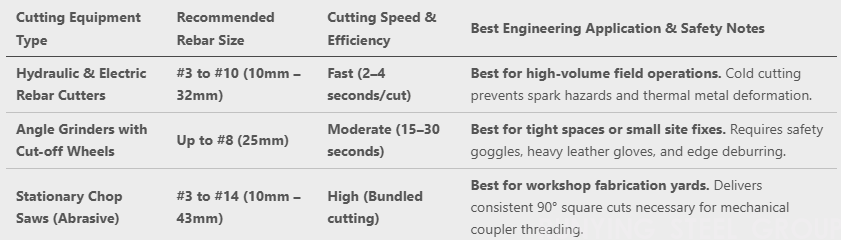
Best for steel rebar 10mm and smaller (#3 and light #4). Portable and inexpensive, but requires physical effort and can deform bar ends.
Manual Rebar Cutters
Purpose-built tools that shear cleaner than bolt cutters. Handle #3 and #4 rebar easily. Many include bending capability.
Hacksaw
Works for small quantities of steel rods 6mm or smaller. Use bi-metal blade with 24-32 TPI. Slow but safe and spark-free.

Method 2: Angle Grinder with Cutoff Wheel
Most popular method for job sites. Handles all steel rebar sizes up to #8 and beyond.
How to cut:
1. Secure rebar firmly
2. Mark cut line
3. Start grinder, let reach full speed
4. Lower wheel gently onto rebar
5. Let wheel cut at its own speed—don't force
6. Deburr sharp edges after cooling
Pros: Fast, versatile, portable, cuts any size
Cons: Sparks, loud, kickback risk, wheel wear
Method 3: Reciprocating Saw (Sawzall)
Excellent for cutting rebar embedded in concrete or in tight spaces.
How to cut:
1. Use bi-metal blade (14-18 TPI)
2. Position blade against rebar
3. Apply steady pressure
4. Let saw do the work
Pros: Fewer sparks, reaches tight spots, good for demolition
Cons: Slower than grinders, significant vibration

Method 4: Dedicated Rebar Cutters (Electric/Hydraulic)
Fastest and safest option for professional use.
Electric Rebar Cutters
Cut #3 to #8 in 2-5 seconds
No sparks, clean cuts, minimal noise
Battery models available for portability
Hydraulic Rebar Cutters
Handle largest sizes (up to #14+)
Powered by electric or gas pumps
Ideal for high-volume industrial work
Method 5: Chop Saw (Stationary)
Best for high-volume repetitive cutting in workshops.
Pros: Fast, consistent, secure clamping
Cons: Stationary, sparks, loud
Steel Rebar Couplers: An Alternative
Steel rebar coupler systems join rebar ends without overlapping, reducing cutting needs. Useful in confined spaces and seismic applications.
Tips for Accurate Cutting
Measure twice, cut once – Verify against drawings
Use stops for repetitive cuts – Ensures identical lengths
Support long bars – Prevents sagging and binding
Deburr after cutting – Remove sharp edges for safety
Replace worn blades – Dull tools cause binding

Why Source Your Steel Rebar from Us?
We are a premier steel exporter based in Tangshan, China—the nation's steel production heartland—strategically located adjacent to Tianjin Port. With over 16 years of export experience, we connect global buyers with world-class steel rebar manufacturers.
Our Product Range
| Product | Specifications |
| Steel rebar 10mm | #3, Grade 40/60, deformed |
| Steel rebar 12mm | #4, Grade 40/60/75, deformed |
| Steel rebar 16mm | #5, Grade 60/75, deformed |
| Steel rebar 20mm | #6, Grade 60/75, deformed |
| Steel rebar 25mm | #8, Grade 60/75, deformed |
| Steel rebar 32mm | #10, Grade 60/75, deformed |
| Steel rods 6mm/5mm/3mm | Plain round, various grades |
| Steel rebar coupler | Complete splicing systems |
Why Partner With Us?
Direct mill access – Long-term partnerships with major manufacturers
Competitive pricing – No intermediaries, better steel rebar price chart values
Complete documentation – Mill certificates with steel rebar tensile strength data
Accurate weight info – Precise steel rebar weight per meter for every size
Professional packaging – Waterproof, secure for ocean freight
Strategic location – Adjacent to Tianjin Port for efficient shipping
Current Price Inquiry
Whether you need steel rebar 12mm for commercial slabs or steel rebar 10mm for residential foundations, contact us for current steel rebar price chart rates.
Frequently Asked Questions
Q: What's the best method for cutting rebar on a small job site?
A: Angle grinder with cutoff wheel offers the best combination of versatility, portability, and cost.
Q: How do I cut rebar without power tools?
A: Bolt cutters or manual rebar cutters work for #3 and #4 (10-12mm). Hacksaw works for small quantities.
Q: What's the difference between #7 and #9 rebar?
A: #7 diameter is 22.2mm, #9 is 28.7mm. Larger sizes carry more weight for heavy structures.
Q: How is steel rebar weight calculated?
A: Weight (kg/m) = d² × 0.006165 (d in mm). Example: steel rebar 12mm = 144 × 0.006165 = 0.888 kg/m.
Q: What affects steel rebar tensile strength?
A: Steel chemistry, manufacturing process, and grade designation. Higher grades have greater strength.
Q: Can you supply steel rebar couplers?
A: Yes, we offer complete steel rebar coupler systems. Contact us with your requirements.
Q: What sizes do you stock?
A: All standard sizes from steel rods 3mm to 40mm, including steel rebar 10mm, 12mm, 16mm, 20mm, 25mm, and 32mm.
Ready to Source Quality Steel Rebar?
Now that you understand how to cut steel rebar, partner with a supplier who delivers quality material every time.
Contact us today with your specifications. Let our 16+ years of export experience and direct mill access provide you with the best steel rebar solutions at truly competitive prices. Request a quote now!