If you are importing galvanized steel coils, pre-painted galvanized steel (PPGI), cold-rolled steel, or other flat steel products, you must ask: What kind of packaging is suitable for the safe ocean transportation of steel coils?
The answer is critical. Poor export packaging inevitably leads to rust, white rust on zinc coatings, edge deformation, telescoping, and costly insurance claims. This comprehensive guide explains the industry‑standard export packing methods that ensure your steel coils arrive at your destination port in perfect condition.
Steel coils are heavy, dense, and highly susceptible to environmental damage. A single coil typically weighs anywhere from 5 to 25 tons. During ocean transit, cargo vessels face constant rolling and pitching, and containers are subjected to shifting G-forces.
Without professional export packaging, you risk facing:
Rust & Corrosion: Caused by salty, highly humid sea air penetrating the container.
Severe Edge Damage: Caused by steel strapping cutting into the coil or physical impact during crane loading.
Telescoping: Inner steel layers sliding sideways, rendering the coil unusable for automatic uncoiling lines.
Structural Shifting: Coils breaking loose inside the container, causing catastrophic shipping accidents.
That is why experienced steel coil manufacturers and exporters adhere to strict international packaging standards.
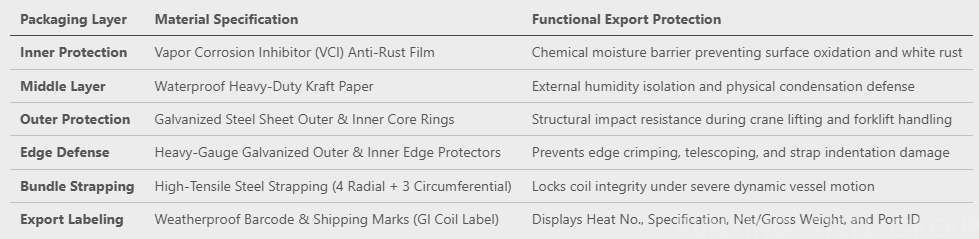
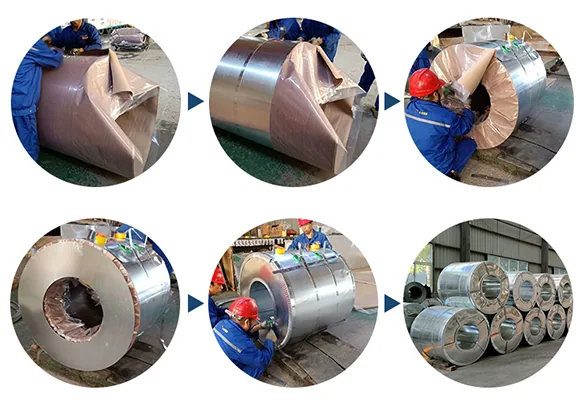
To withstand weeks on the ocean, every steel coil we export is wrapped in a robust, multi-layered protective envelope:
1, Inner Moisture Barrier (VCI Protection)
The coil is first wrapped in premium VCI (Vapor Corrosion Inhibitor) paper or film. VCI releases protective vapors that form an invisible, molecular anti-rust layer on the steel surface. For GI (galvanized) and GL (galvalume) coils, this neutral layer is absolutely vital to prevent zinc oxidation (often called "white rust").
2, Waterproof Plastic Wrapping
A heavy-duty, waterproof polyethylene or PVC plastic film is wrapped tightly over the VCI layer. This creates a hermetic seal against salt spray, marine condensation, and rain during port transfers. While hot-rolled steel is more forgiving, cold-rolled (CR) and PPGI coils demand a flawless moisture barrier.
3, Heavy-Duty Edge Protectors
Cardboard or high-impact plastic edge protectors are secured along both the inner and outer circumferences of the coil. These protectors act as a cushion, preventing high-tensile steel straps from biting into the sharp edges of the steel coil.
4, High-Tensile Steel Strapping
To prevent telescoping, multiple high-tensile steel straps are radially threaded through the "eye" (inner diameter) of the coil, along with multiple circumferential bands. The number of straps scales with the coil's size and weight to guarantee structural integrity.

Galvanized Steel Coil Export Packing Standards by Category
Different steel grades require specialized packaging considerations. Below is our standardized export packing protocol:
| Coil Type | Core Packaging Concerns | Standard Packaging Solution |
|---|---|---|
| Galvanized Steel Coil (GI) | Preventing zinc oxidation (white rust) | Neutral VCI paper + galvanized steel outer sheet protector |
| Galvalume Steel Coil (GL) | Preventing edge corrosion on Al-Zn coatings | Reinforced inner & outer metal edge ring protectors |
| PPGI / PPGL (Pre-painted) | Preventing paint scratches and surface marring | Soft protective interleaving paper + outer plastic sleeve |
| Cold Rolled Coil (CRC) | High sensitivity to moisture & fingerprint rust | Complete VCI wrapping + thick steel outer envelope packaging |
| Hot Rolled Coil (HRC) | Scale protection and physical shifting | Heavy-duty steel strapping with basic rust-preventative oil |
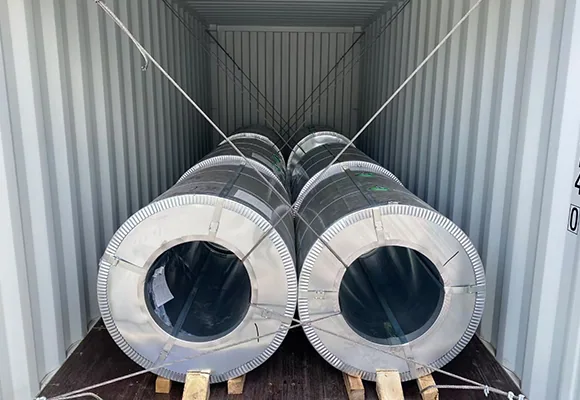
Even the most robust packaging will fail if the coils are allowed to roll freely inside a shipping container. For safe container shipments, we implement the following securing measures:
Heavy-Duty Wooden Cradles (Dunnage): Coils rest on custom-contoured wooden blocks to distribute the weight evenly across the container floor.
Fumigated Wood Chocking: Wooden wedges are nailed securely to the container floor to eliminate rolling.
Lashing & Strapping: Heavy-duty steel wire ropes or high-tensile polyester lashing bands are threaded through the coil's eye and anchored to the container’s d-rings.
Inflatable Dunnage Airbags: Placed in voids to prevent side-to-side shifting during rough sea state transits.

Based in Tangshan, China—the heart of the country's steel production—and operating directly next to Tianjin Port, we leverage over 16 years of steel export experience.
We work hand-in-hand with major Chinese steel coil factories to supply premium flat steel products while ensuring world-class packaging:
Certified Materials: We supply GI, GL, PPGI, and Cold-Rolled coils in custom sizes and coating weights (e.g., Z275 zinc coating).
Export-Proven Packing: Every order is packaged using our standard VCI + steel envelope system, completely optimized for sea freight.
Logistics Expertise: We specialize in securing container loads, offering competitive ocean freight rates and transparent 24-ton steel coil container pricing.
A: Our export-grade VCI packaging provides active corrosion protection for up to 10 to 12 months when stored in a dry, covered warehouse. This easily covers the duration of long-distance ocean shipping and custom clearance.
Q2: Why is "white rust" common on galvanized coils, and how does your packaging prevent it?
A: White rust (zinc hydroxide) occurs when zinc-coated steel is exposed to moisture and oxygen simultaneously without sufficient airflow. Our airtight outer plastic wrap combined with moisture-absorbing VCI paper completely isolates the zinc coating from ocean humidity.
Don't let poor logistics damage your investments. Partner with an experienced exporter who understands that high-quality steel is only as good as the packaging it arrives in.
Contact our export team today with your required steel grade, thickness, zinc coating weight, and destination port. We will provide a competitive quotation and complete packaging specifications within 24 hours.